Wishlist

10 Best Calisthenics Park Exercises for Beginners and Pros
Calisthenics parks turn public spaces into practical, free workout environments where you can develop strength, mobility, balance, and body control. Whether you are completely new to bodyweight training or already working toward advanced skills, the bars, benches, and open space can support a surprisingly complete workout.
Research increasingly supports the value of outdoor fitness equipment. A randomized controlled trial found that eight weeks of resistance training using outdoor fitness equipment improved lean mass, muscular strength, and physical functioning in middle-aged and older adults.
1. Push-Ups
Push-ups are one of the best starting points for a calisthenics workout because they require no complicated equipment. Use a low bar or bench for an easier incline variation, then progress toward standard, decline, diamond, or explosive push-ups as your strength improves.
Keep your body in a straight line and lower your chest under control. For advanced athletes, slower repetitions, pauses, and explosive variations can make a familiar movement considerably harder.
2. Pull-Ups
A pull-up bar is arguably the most valuable piece of equipment in a calisthenics park. Beginners can start with assisted or negative pull-ups, while experienced athletes can progress toward weighted pull-ups, archer pull-ups, and eventually muscle-ups.
Chris Heria, a professional calisthenics athlete and trainer known for popularizing bodyweight training through his coaching and fitness platforms, emphasizes progression. He explains that “every movement has its own progression tree,” highlighting how exercises can continually become more challenging.

3. Dips
Parallel bars make dips an excellent choice for developing the chest, shoulders, and triceps. Beginners can use a reduced range of motion or assisted variation, while pros can add weight or work toward more advanced straight-bar movements.
Research on outdoor resistance training has found improvements in upper- and lower-body strength following structured outdoor equipment program.
4. Bodyweight Squats
Do not overlook your legs. Bodyweight squats are simple enough for beginners but can become challenging when you introduce tempo changes, pauses, jump squats, or single-leg progressions.
Calisthenics coach Al Kavadlo recommends establishing a strong foundation before chasing advanced skills. He specifically suggests that newcomers build capacity with basic movements before progressing toward exercises such as pistol squats and human flags.
5. Australian Pull-Ups
Also called inverted rows, Australian pull-ups are particularly useful when you are not yet strong enough to perform conventional pull-ups. Set a low bar at a suitable height, keep your body rigid, and pull your chest toward the bar.
Chris Heria has also recommended body rows as a lower-difficulty horizontal pulling exercise, making them a useful bridge between beginner training and more demanding pulling movements.

6. Hanging Knee Raises
Hanging knee raises turn a pull-up bar into an effective core-training station. Start by bringing your knees toward your chest, then progress toward straight-leg raises and toes-to-bar.
Focus on controlled movement rather than swinging. Stronger athletes can increase the difficulty by slowing the lowering phase or progressing toward advanced hanging movements.
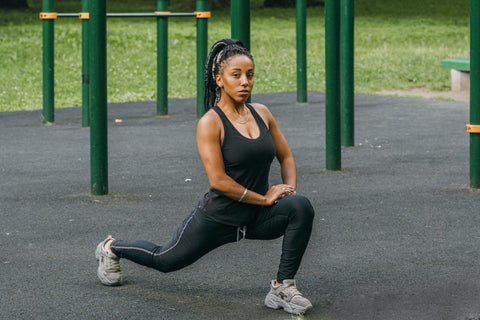
7. Walking Lunges
Walking lunges require little equipment and train the legs while challenging balance and coordination. They are particularly useful in an outdoor workout because you can use the surrounding open space for repeated steps.
For beginners, take shorter steps and concentrate on stability. More advanced athletes can add jump lunges, weighted variations, or longer sets to increase the challenge.
8. Pistol Squats
Pistol squats are an advanced single-leg exercise that combines strength, balance, mobility, and control. Beginners should first master regular squats and assisted single-leg squats before attempting the full movement.
Outdoor fitness research also suggests that thoughtful park design matters. A study of outdoor fitness areas found that surface type, suitable equipment, shade, and nearby seating were among the most important design features for older adults.

9. Planks
The humble plank remains one of the most accessible exercises at a calisthenics park. It develops trunk stability and can be performed almost anywhere without equipment.
Frank Medrano, a professional calisthenics athlete and trainer known for his bodyweight training career, describes the plank as a foundational calisthenics exercise. His philosophy is equally straightforward: “Your body is a gym.”
Try standard planks first, then experiment with side planks, shoulder taps, and longer-duration holds as your control improves.
10. Muscle-Ups
The muscle-up is where beginner-friendly park training can eventually lead. Combining a powerful pull with a transition into a dip, it demands substantial upper-body strength, coordination, timing, and technique.
Do not rush this movement. Build your pull-ups, dips, explosive pulling strength, and transition technique first, ideally with qualified coaching if you are struggling with the movement.
Why Calisthenics Parks Are Worth Using
The appeal of outdoor training goes beyond convenience. A 2024 study of age-friendly outdoor exercise equipment found that installing specialized equipment alongside community support increased park visitation and supported park-based physical activity among older adults.
There is also growing evidence that these facilities are becoming more common. A study of Aotearoa New Zealand found 122 parks with outdoor gym equipment across the country's 10 most populated territorial authorities, with observed equipment averaging 16 uses per hour at one large urban park.
This makes the calisthenics park a potentially useful alternative to an indoor gym, particularly for people who enjoy training outdoors. The best approach is to start with movements you can perform safely and gradually increase difficulty.

Build Your Own Outdoor Routine
A beginner could start with three rounds of squats, incline push-ups, Australian pull-ups, lunges, and planks. Rest as needed and prioritize controlled technique rather than chasing maximum repetitions.
More experienced athletes can structure sessions around strength and skill. Pull-ups, dips, pistol squats, hanging raises, and muscle-up progressions can form the foundation of a demanding street workout parks routine.
The key is progression. You do not need to master the hardest exercise on day one, and you should not judge your progress against someone who has trained for years.
From First Rep to Advanced Skill
One of the greatest advantages of outdoor bodyweight training is its scalability. The same park can accommodate someone performing their first assisted pull-up and an experienced athlete practicing advanced skills.
Research into outdoor gym equipment in New Zealand found that the equipment surveyed was functional and showed potential for frequent use, although availability varied considerably between locations.
That flexibility is what makes calisthenics parks so appealing. Start with the fundamentals, learn good movement patterns, and gradually turn simple exercises into increasingly challenging variations.
Make the Park Your Playground
The best calisthenics park exercises are not necessarily the most spectacular ones. Push-ups, squats, rows, pull-ups, dips, lunges, planks, and their progressions can build an impressive foundation before you ever attempt a muscle-up or pistol squat.
Outdoor fitness research continues to show that well-designed exercise spaces can encourage physical activity and support strength and functional fitness.
So find a suitable park, start at your current ability level, and focus on steady progression. Your first workout may involve nothing more than a few basic movements, but with consistency, those same bars can become the starting point for advanced calisthenics skills.
About the Author

Isla Douglas
Isla Douglas is a seasoned travel writer known for her immersive storytelling and vivid descriptions. Beyond her writing, she is passionate about sustainable tourism and responsible travel, inspiring readers to explore the world thoughtfully. When not writing, Isla enjoys hiking, photography, and culinary adventures.